

Joy In The Ruins
A surprising pilgrimage to Tintern Abbey in Wales

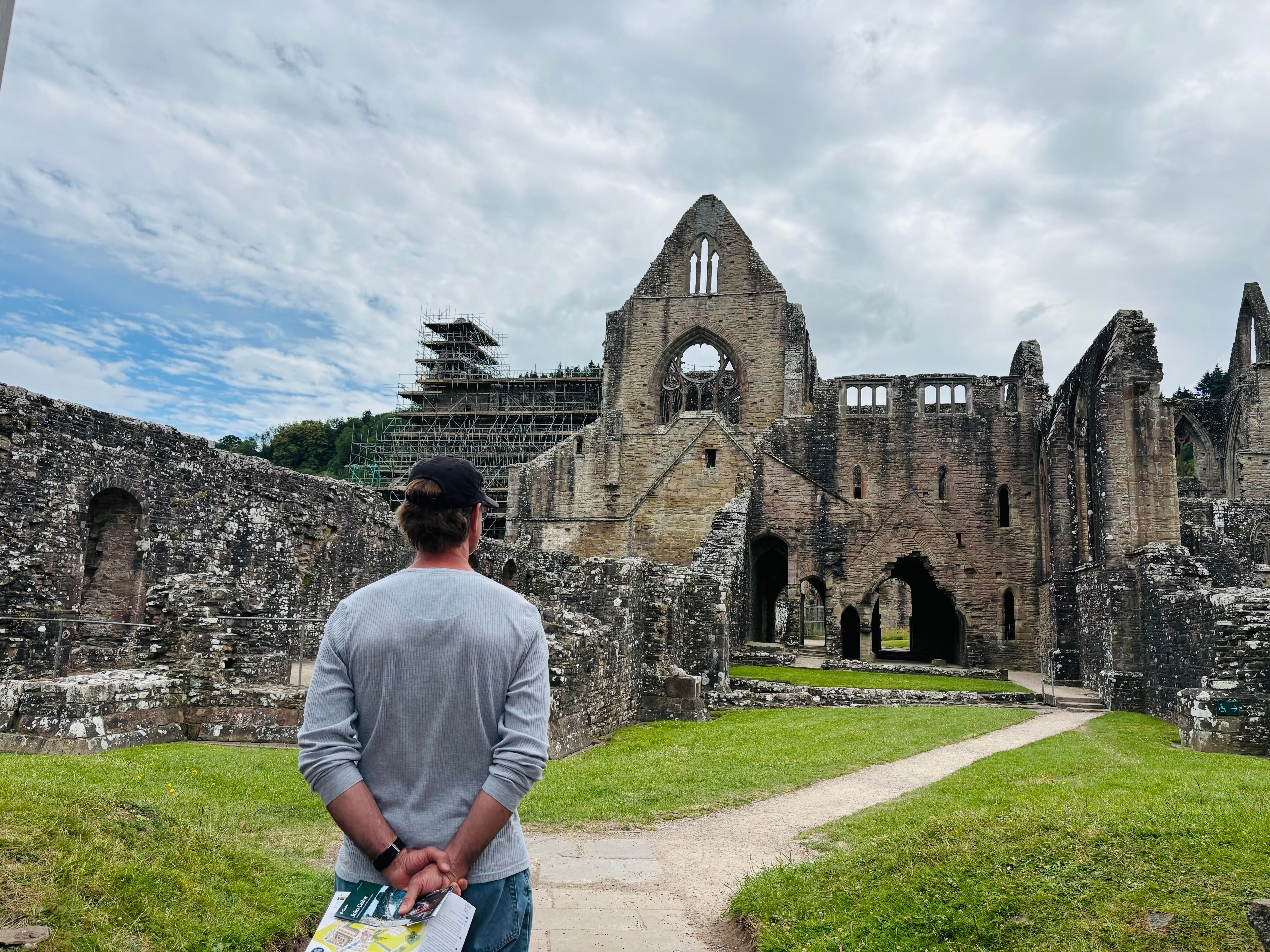
Last week on the way over here I wrote about liminal moments in travel—watching a movie thirty thousand feet over the ocean—and the threshold moments have continued as Pam and I have wandered and hiked over southern Wales.
When I discovered that Tintern Abbey was just a few miles from our cottage, it seemed like fantasy had become real—like finding out that the Emerald City or Hogwarts was just down the road. In grad school, 1979, I had first read Wordsworth’s account of his visit to the 12th century Cistercian monastery. Over the years I have come back to that poem many times—it was the centerpiece of a Lenten reflection I wrote just a few months ago. But I never thought I’d visit that storied place. It was already in ruins when Wordsworth beheld it in 1798—it seemed like Camelot, lost to the ages. But there it was in the guidebook. Latter-day Wordsworths were still contemplating the remains of the place.
After 800 years and the ravages of Henry VIII’s brutal disestablishment of English monasteries in 1536, the place still looked pretty good. It’s hard to bring down tons of stone, however delicately carved. We walked through the ruins of the kitchen, refectory, infirmary, lavatory, the cloisters, and then the massive nave of the church, the stone tracery of the rose window still intact.
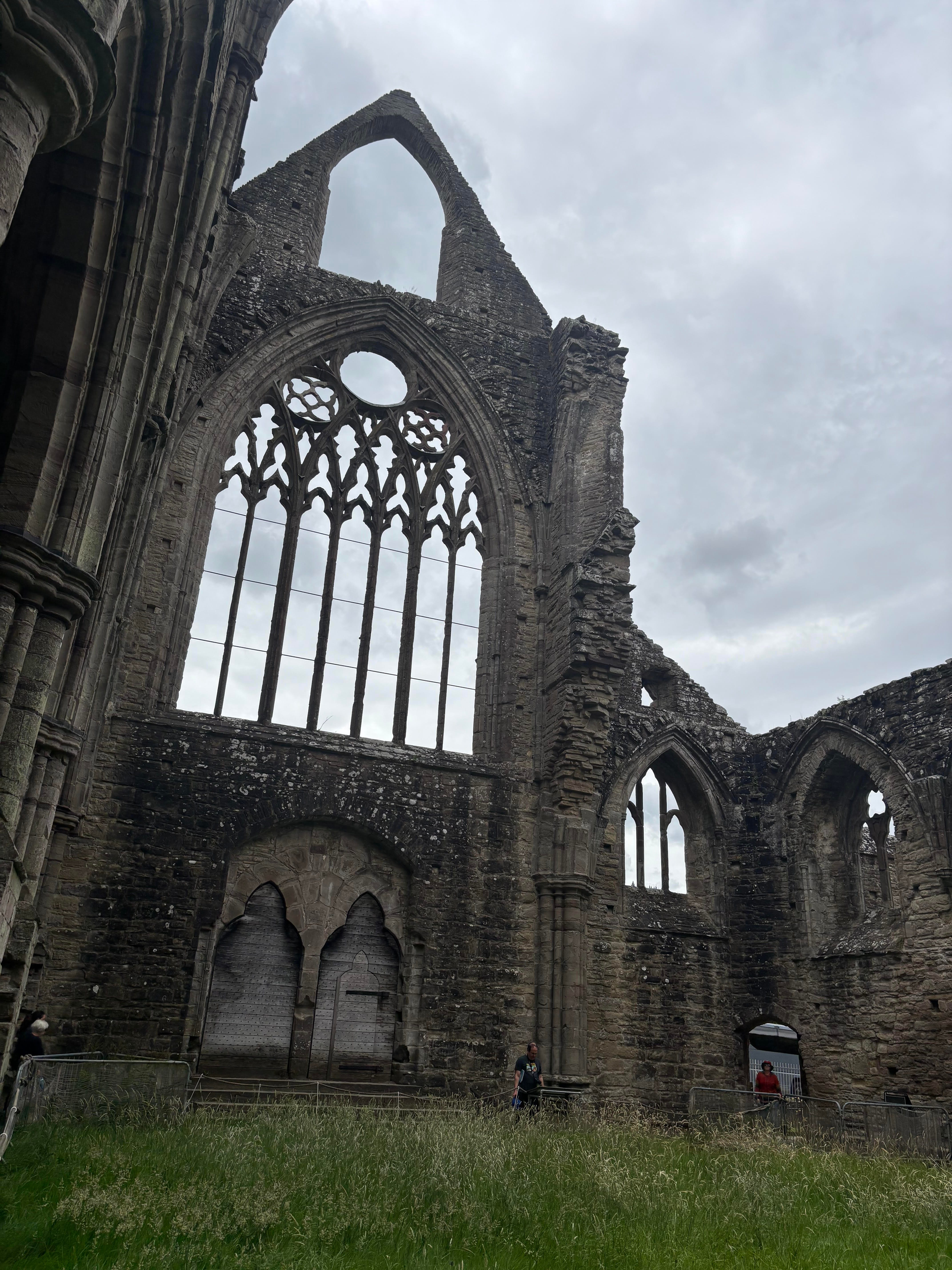
Past became present. It took little imagination to see the high altar, hear the chanting of a hundred monks, and wonder at a world where places like this—set apart for endless praise—were a part of everyday life.
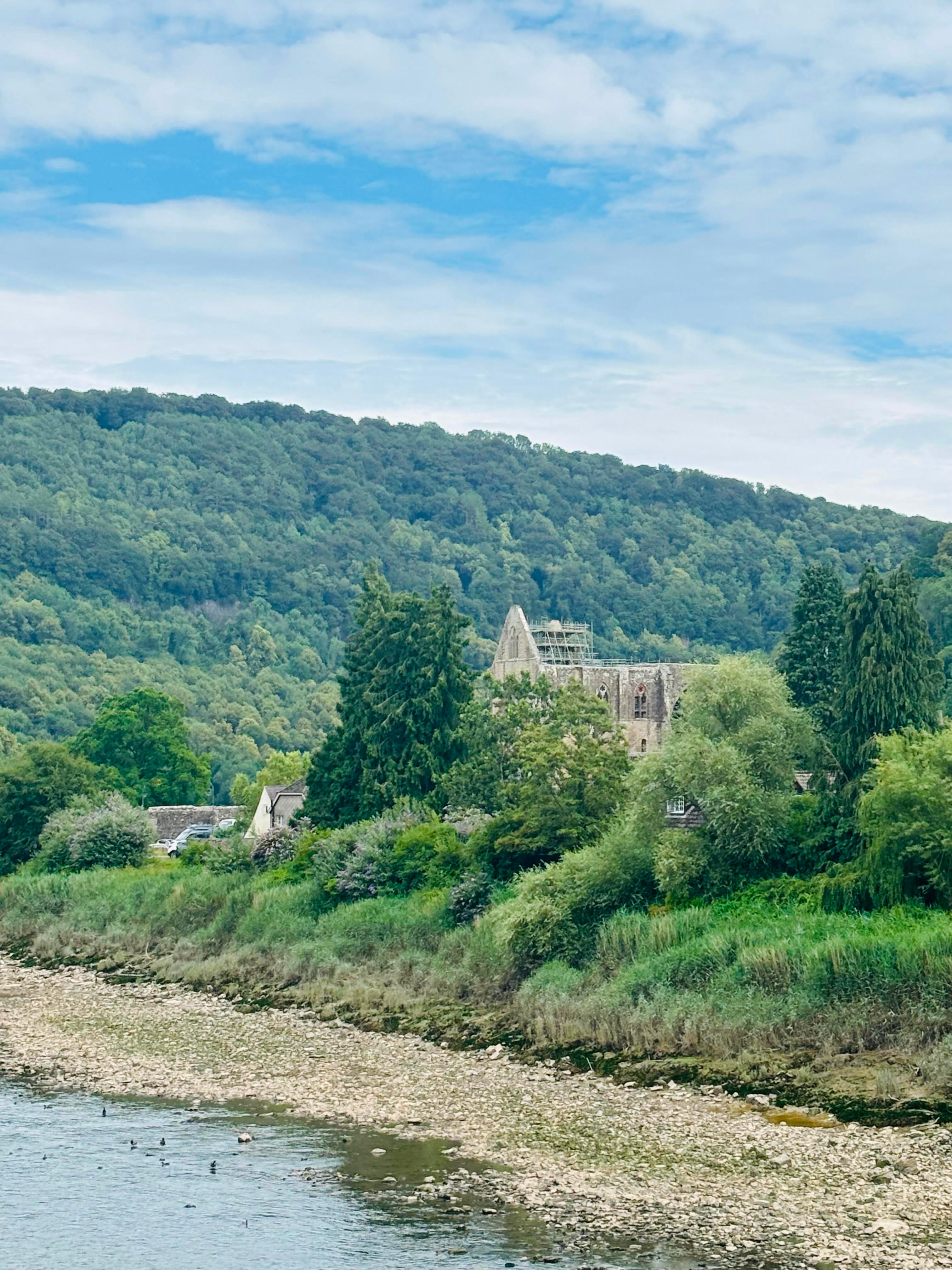
Then we left the crumbling abbey, crossed a little footbridge, and walked up along a path beside the Wye river. We were all alone, no one else in sight. Wordsworth’s poem is entitled, “Lines Composed a Few Miles above Tintern Abbey, On Revisiting the Banks of the Wye during a Tour. July 13, 1798.” Somewhere about here, we said, is where William sat—actually, the poem says he “reposed” under a dark sycamore. But we sat down on a low wall under a riot of vines and nameless trees and I read his poem aloud.
It’s a romantic reverie on youth and aging, beauty and nature, a meditation on how the passing of time shapes callowness into wisdom. I’m reading the lines and thinking how very young I was when I first read them. Wordsworth remembers his boyhood, when “like a roe/ I bounded o’er the mountains, by the sides/ Of the deep rivers, and the lonely streams,/Wherever nature led.”
“That time is past,” he goes on to say, “and all its aching joys are now no more.”
I had a childhood like that—a favorite Mulberry tree I loved to climb, a creek I waded in search of crawdads, a verdant baseball park in town, my own Field of Dreams. And overlooking this ruined monastery, I can’t help but see my church—the little white clapboard Swedish Baptist church of those halcyon days. The ease of belief. The certainty of heaven. That time is past, yes, and all its aching joys are no more.
About now a red tractor comes putting down the path, and I pause my reading as the farmer passes by, on his way to one of the many fields on these green hills. I smile. Here I am trying to recreate a scene from 1798 and the modern world crashes the set. The world churns on, undoing every effort to regain the past, to feel again those aching joys.
But I resume reading aloud because the interruption is the point. Wordsworth goes on to say that for all those losses, aging brings with it “abundant recompense.” He can never recapture his careless days, but the passing years bestow a deeper vision of life.
For I have learned
To look on nature, not as in the hour
Of thoughtless youth; but hearing oftentimes
The still, sad music of humanity,
Nor harsh nor grating, though of ample power
To chasten and subdue. And I have felt
A presence that disturbs me with the joy
Of elevated thoughts; a sense sublime
Of something far more deeply interfused,
Whose dwelling is the light of setting suns,
And the round ocean, and the living air,
And the blue sky, and in the mind of man;
A motion and a spirit, that impels
All thinking things, all objects of all thought,
And rolls through all things.
That, or something like that, is what I have found—a “disturbing joy,” a peace that isn’t in denial about all those losses and yet still persists. At least on my good days. On my bad days I lose the joy and am just plain disturbed. But there are moments when, like T. S. Eliot, I catch just “a tremor of bliss, a wink of heaven, a whisper.” And I am learning to let that be enough.
Lines Composed a Few Miles above Tintern Abbey, On Revisiting the Banks of the Wye during a Tour. July 13, 1798By William WordsworthFive years have past; five summers, with the length Of five long winters! and again I hear These waters, rolling from their mountain-springs With a soft inland murmur.—Once again Do I behold these steep and lofty cliffs, That on a wild secluded scene impress Thoughts of more deep seclusion; and connect The landscape with the quiet of the sky. The day is come when I again repose Here, under this dark sycamore, and view These plots of cottage-ground, these orchard-tufts, Which at this season, with their unripe fruits, are clad in one green hue, and lose themselves ‘Mid groves and copses. Once again I see These hedge-rows, hardly hedge-rows, little lines Of sportive wood run wild: these pastoral farms, Green to the very door; and wreaths of smoke Sent up, in silence, from among the trees! With some uncertain notice, as might seem Of vagrant dwellers in the houseless woods, Or of some Hermit’s cave, where by his fire The Hermit sits alone.
                                    These beauteous forms,
Through a long absence, have not been to me
As is a landscape to a blind man’s eye:
But oft, in lonely rooms, and ‘mid the din
Of towns and cities, I have owed to them,
In hours of weariness, sensations sweet,
Felt in the blood, and felt along the heart;
And passing even into my purer mind
With tranquil restoration:—feelings too
Of unremembered pleasure: such, perhaps,
As have no slight or trivial influence
On that best portion of a good man’s life,
His little, nameless, unremembered, acts
Of kindness and of love. Nor less, I trust,
To them I may have owed another gift,
Of aspect more sublime; that blessed mood,
In which the burthen of the mystery,
In which the heavy and the weary weight
Of all this unintelligible world,
Is lightened:—that serene and blessed mood,
In which the affections gently lead us on,—
Until, the breath of this corporeal frame
And even the motion of our human blood
Almost suspended, we are laid asleep
In body, and become a living soul:
While with an eye made quiet by the power
Of harmony, and the deep power of joy,
We see into the life of things.
                                                    If this
Be but a vain belief, yet, oh! how oft—
In darkness and amid the many shapes
Of joyless daylight; when the fretful stir
Unprofitable, and the fever of the world,
Have hung upon the beatings of my heart—
How oft, in spirit, have I turned to thee,
O sylvan Wye! thou wanderer thro’ the woods,
How often has my spirit turned to thee!

And now, with gleams of half-extinguished thought,
With many recognitions dim and faint,
And somewhat of a sad perplexity,
The picture of the mind revives again:
While here I stand, not only with the sense
Of present pleasure, but with pleasing thoughts
That in this moment there is life and food
For future years. And so I dare to hope,
Though changed, no doubt, from what I was when first
I came among these hills; when like a roe
I bounded o’er the mountains, by the sides
Of the deep rivers, and the lonely streams,
Wherever nature led: more like a man
Flying from something that he dreads, than one
Who sought the thing he loved. For nature then
(The coarser pleasures of my boyish days
And their glad animal movements all gone by)
To me was all in all.—I cannot paint
What then I was. The sounding cataract
Haunted me like a passion: the tall rock,
The mountain, and the deep and gloomy wood,
Their colours and their forms, were then to me
An appetite; a feeling and a love,
That had no need of a remoter charm,
By thought supplied, nor any interest
Unborrowed from the eye.—That time is past,
And all its aching joys are now no more,
And all its dizzy raptures. Not for this
Faint I, nor mourn nor murmur; other gifts
Have followed; for such loss, I would believe,
Abundant recompense. For I have learned
To look on nature, not as in the hour
Of thoughtless youth; but hearing oftentimes
The still sad music of humanity,
Nor harsh nor grating, though of ample power
To chasten and subdue.—And I have felt
A presence that disturbs me with the joy
Of elevated thoughts; a sense sublime
Of something far more deeply interfused,
Whose dwelling is the light of setting suns,
And the round ocean and the living air,
And the blue sky, and in the mind of man:
A motion and a spirit, that impels
All thinking things, all objects of all thought,
And rolls through all things. Therefore am I still
A lover of the meadows and the woods
And mountains; and of all that we behold
From this green earth; of all the mighty world
Of eye, and ear,—both what they half create,
And what perceive; well pleased to recognise
In nature and the language of the sense
The anchor of my purest thoughts, the nurse,
The guide, the guardian of my heart, and soul
Of all my moral being.
                                               Nor perchance,
If I were not thus taught, should I the more
Suffer my genial spirits to decay:
For thou art with me here upon the banks
Of this fair river; thou my dearest Friend,
My dear, dear Friend; and in thy voice I catch
The language of my former heart, and read
My former pleasures in the shooting lights
Of thy wild eyes. Oh! yet a little while
May I behold in thee what I was once,
My dear, dear Sister! and this prayer I make,
Knowing that Nature never did betray
The heart that loved her; ‘tis her privilege,
Through all the years of this our life, to lead
From joy to joy: for she can so inform
The mind that is within us, so impress
With quietness and beauty, and so feed
With lofty thoughts, that neither evil tongues,
Rash judgments, nor the sneers of selfish men,
Nor greetings where no kindness is, nor all
The dreary intercourse of daily life,
Shall e’er prevail against us, or disturb
Our cheerful faith, that all which we behold
Is full of blessings. Therefore let the moon
Shine on thee in thy solitary walk;
And let the misty mountain-winds be free
To blow against thee: and, in after years,
When these wild ecstasies shall be matured
Into a sober pleasure; when thy mind
Shall be a mansion for all lovely forms,
Thy memory be as a dwelling-place
For all sweet sounds and harmonies; oh! then,
If solitude, or fear, or pain, or grief,
Should be thy portion, with what healing thoughts
Of tender joy wilt thou remember me,
And these my exhortations! Nor, perchance—
If I should be where I no more can hear
Thy voice, nor catch from thy wild eyes these gleams
Of past existence—wilt thou then forget
That on the banks of this delightful stream
We stood together; and that I, so long
A worshipper of Nature, hither came
Unwearied in that service: rather say
With warmer love—oh! with far deeper zeal
Of holier love. Nor wilt thou then forget,
That after many wanderings, many years
Of absence, these steep woods and lofty cliffs,
And this green pastoral landscape, were to me
More dear, both for themselves and for thy sake!
David, thanks for the gift this morning of “a tremor of bliss, a wink of heaven, a whisper.”
Poetry gives us eyes to see and ears to hear what is all around us, although normally we remain blind and deaf to it all. Just a glimpse, and enough wisdom to know it's my lack of sight rather than a lack of the miraculous that stops me from seeing it - and my lack of a discerning ear that keeps me from hearing it. Thanks, David!