

Cold As Hell
Why have we focused only on the fire of hell, and missed the ice?

Mars ain’t the kind of place to raise your kids,
In fact it’s cold as hell.
“Rocket Man,” Elton John
“Hell,” you might be surprised to know, never appears in the Bible. In the Old Testament, there’s sheol, and in the New Testament there are gehenna, tartaurus and hades. We get “hell” from English translations of those four, very different biblical words. So where the hell did “hell” come from? Well, it originated in ancient Norse mythology. Hel is the name of the goddess of the underworld and death, as well as the name for the realm she rules. And get this, Hel is a cold, dark and misty place—not a lake of fire—which makes all the Nordic sense in the world.
Hell is cold?
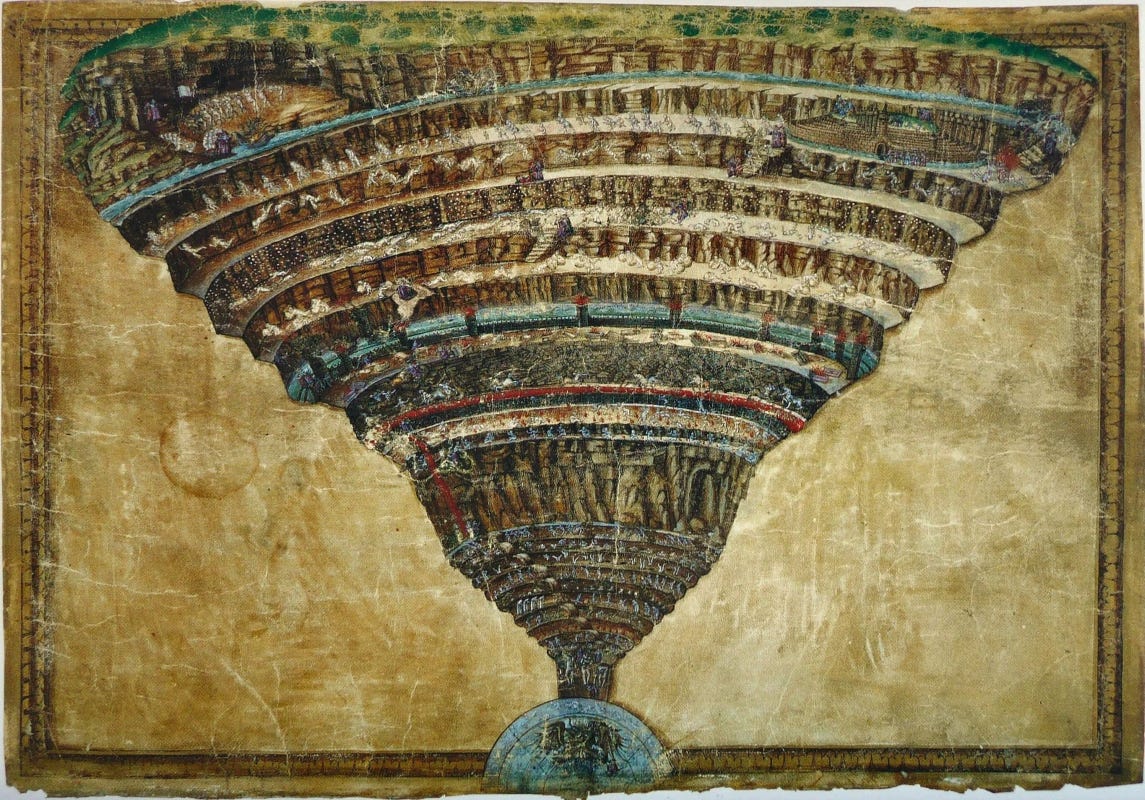
If you live east of the Rockies these days, where frigid temps and multiple snowstorms have blasted for weeks on end, you’ve probably been thinking it’s cold as hell. And you’d be right. In his iconic descriptions of Inferno, the Italian word for hell, Dante leads us through nine neighborhoods of the underworld. There are indeed flames in the upper levels, but the deeper you go, the colder it gets, until we reach the ninth and bottom level where Satan is frozen up to his waist in a lake of his own tears. Locked in perpetual ice.
That image ought to give us pause: maybe we don’t know jack about hell.
Dante almost certainly based his final, frozen ring of punishment on Zamhereer, a zone of hideous cold at the bottom of hell in some Islamic traditions. Zamhereer is unbearably frigid, continually buffeted by blizzards, ice and snow. It’s the perfect place for Satan—frozen at the bottom of hell—because, the Muslims believed, it dramatically underscored his eternal restriction and impotence.
Tibetan Buddhists tell the same story. They have sixteen hellish places called Narakas, eight hot and eight fiercely cold.

Why have we focused only on the fire of hell, and missed the ice? Why have we entertained only the childish picture of hell as a firestorm of punishment for those who don’t believe what we believe, as a flaming cave of molten lava presided over by a triumphant, horned devil? The icy version is a far more potent image of the soul far from God.
Heat and cold are, of course, measurements of energy. Exposed to heat, molecules start jumping, but when heat is withdrawn, they slow until they stop. If we think of Divine love as an all-consuming, purifying fire, the goal of spiritual (or merely human) life is to move closer and closer to that fire, where there is warmth, energy, movement. The further we move away from the flame, the more we fall into a cold, lifeless torpor. Think, finally, of Satan: forever frozen.
An icy hell is making a lot of sense this winter, not just because I’ve been trapped in a Siberian prison for weeks on end, but because it’s a clear corrective to that blinkered view of fire and brimstone. If we drop the old trope of hell as burning retribution for others, we can see it as a stark image not of punishment but as self-inflicted exile-in-ice. It’s what awaits any and all of us who feel the warmth of the empyreal Fire…but choose to walk further and further away from it.
Every day we have that choice. Do we want to want the fire of heaven or the ice of hell? It’s foolish to imagine that heaven and hell are future destinations. As Catherine of Siena reminds us, “All the way to heaven is heaven.” And we could say, All the way to hell is hell. It’s all happening now. Eternity is never later. I’m no philosopher, but Ludwig Wittgenstein nailed it: “If we take eternity to mean not infinite temporal duration but timelessness, then eternal life belongs to those who live in the present.” In every moment, then, we can choose warmth, light and joy.
Near the end of Paradiso, Dante speaks of “The love that moves the suns and the other stars.” Isn’t that remarkable? What powers every planet and galaxy, sun and star, in an awesome, fiery, astonishingly choreographed dance is Love. It’s hard to resist that powerful force, but we’ve all been created with the freedom and the power to do so. That way leads to ice. Choose fire.
I agree. I.C.E. is Hell. (pun intended)
David, as it happens, I’m reading this in a hotel lobby in Atlanta. Outdoors, they say, it feels like 22.
At age 77, I think about the afterlife more than I used to. But as you say—all this focus on the future steals from the lovely now. I like Wittgenstein’s word on this. I’ll take it.
And Robert Frost has a word on this too. Actually two words, perfect for your meditation this morning: “Fire and Ice”
Some say the world will end in fire,
Some say in ice.
From what I’ve tasted of desire
I hold with those who favor fire.
But if it had to perish twice,
I think I know enough of hate
To say that for destruction ice
Is also great
And would suffice.